


Table of Contents
Introduction: From Vacuum Failures to Farming Revolution
When James Dyson built his 5,127th prototype of a bagless vacuum cleaner, he had no idea that the same relentless engineering philosophy would one day transform him into Britain’s largest farmer. Today, Dyson strawberry farming represents one of the most ambitious applications of high-tech innovation to agriculture ever attempted in the United Kingdom.
The numbers tell an extraordinary story. After spending five years and creating over five thousand prototypes to perfect a single vacuum cleaner design, Dyson has now invested £140 million into a farming operation spanning 36,000 acres across five English counties. At the heart of this agricultural empire sits a 26-acre glasshouse in Lincolnshire, home to 1.25 million strawberry plants and technology that has increased yields by 250% compared to traditional farming methods.
This isn’t farming as your grandparents would recognize it. Inside Dyson’s facility, massive 5.5-meter “ferris wheel” structures rotate strawberry plants through optimal sunlight positions. Sixteen robotic arms delicately harvest ripe fruit using computer vision. UV-emitting robots patrol the aisles at night, destroying mould without chemicals. And all of it runs on renewable energy generated from an adjacent anaerobic digester.
The 5,127 Prototype Philosophy
Understanding why a vacuum cleaner manufacturer became Britain’s most innovative farmer requires understanding James Dyson’s fundamental approach to engineering: iterate, fail, learn, repeat.
Born in Norfolk in 1947, Dyson lost his father at age nine and was sent to boarding school. Despite being described as a “terrible student,” he discovered a passion for design at the Royal College of Art. His journey to the cyclonic vacuum cleaner began in 1978 when frustration with his constantly clogging Hoover Junior sparked an idea. He’d noticed a local sawmill using cyclone technology to separate sawdust from air. Could the same principle work in a vacuum?
What followed became a masterclass in persistence. Working from his coach house, supported by his wife’s salary as an art teacher, Dyson built one prototype after another. The process took five years and 5,127 attempts before he created the “Dual Cyclone,” the world’s first bagless vacuum cleaner. Every major manufacturer rejected his design because the vacuum bag market was worth over $500 million annually in Europe alone.
“I made 5,127 prototypes of my vacuum before I got it right,” Dyson told Fast Company in 2007. “There were 5,126 failures. But I learned from each one. That’s how I came up with a solution. So I don’t mind failure.”
This philosophy now drives everything at Dyson Farming. The Hybrid Vertical Growing System underwent 12 months of painstaking development. Engineers designed, tested, and refined every component before declaring the trial complete. The result? A 250% increase in strawberry yields while maintaining exceptional fruit quality.
How Dyson Strawberry Farming Technology Works
The Carrington glasshouse in Lincolnshire is unlike any farming facility in the world. Stretching 760 meters (approximately 2,500 feet), the structure houses technology that blurs the line between agriculture and precision manufacturing.
At the core of the operation is a climate control computer system that maintains optimal growing conditions 24 hours a day, 365 days a year. Temperature, humidity, CO2 levels, and light exposure are constantly monitored and adjusted. On darker winter days, LED lights supplement natural sunlight. During colder months, waste heat from the adjacent anaerobic digester keeps plants at ideal temperatures.
The growing infrastructure itself uses “swinging gutters” that hold strawberry plants and move side to side, increasing crop density by 15% in the same floor space. But the real breakthrough came with the Hybrid Vertical Growing System (HVGS), which takes space efficiency to an entirely new level.
AI-powered decision support software analyzes data from smart sensors throughout the facility. This information guides everything from irrigation timing to harvest scheduling. The system can predict exactly when each strawberry will reach peak ripeness, ensuring optimal quality for consumers.
The Ferris Wheel Growing System
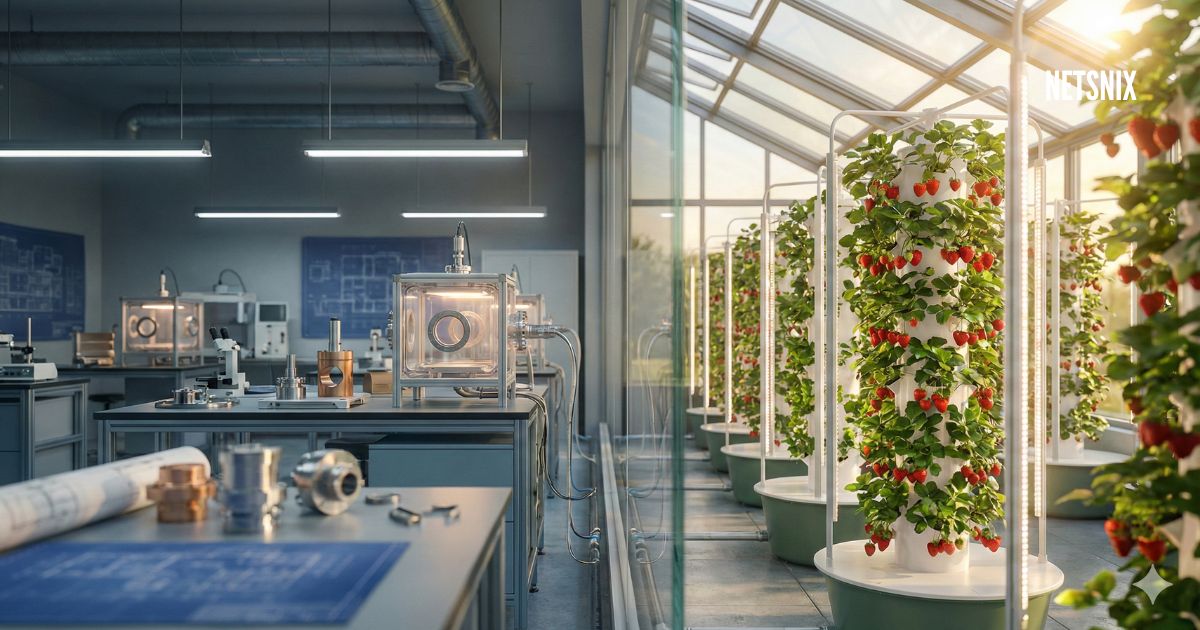
The Hybrid Vertical Growing System is, quite simply, the biggest machine Dyson has ever built. Two aluminium rigs, each larger than two double-decker buses placed end-to-end, support rotating frames that carry strawberry plants through a continuous cycle of optimal light exposure.
Each “ferris wheel” structure stands 5.5 meters tall and stretches 24 meters long. They weigh approximately 500 kilograms (1,100 pounds) and host ten rows of strawberry plants. The wheels rotate slowly throughout the day, ensuring every plant receives maximum natural sunlight while supplementary LED lighting fills gaps during darker periods.
“We designed and built every aspect of the Hybrid Vertical Growing System ourselves,” said Rob Kyle, a Dyson engineer involved in the project. “It has been a painstaking labour of love over the past 12 months. We’ve built the biggest machines in Dyson’s history and filled them with 6,000 strawberry plants.”
The results exceeded all expectations. Trial data showed the vertical growing system achieved 250% higher yields than traditional horizontal arrangements while maintaining—and in many cases improving—fruit quality. The rotating mechanism ensures consistent sun exposure across all plants, eliminating the uneven ripening that often plagues conventional strawberry farming.
Daniel Cross from Dyson Farming emphasized the broader implications: “The trial shows how the yields of delicious, high-quality fruit grown vertically under glass in the right conditions can be significantly increased. This need not only apply to strawberries. There is much more we can do.”
Robots, AI, and Precision Agriculture
If the ferris wheel system represents Dyson’s hardware innovation, the robotic systems represent their software and automation expertise. The glasshouse employs several specialized robots, each designed to solve a specific agricultural challenge.
Robotic Harvesters: Sixteen robotic arms equipped with vision sensing technology patrol the growing areas. Using cameras and AI, they identify ripe strawberries by analyzing size, shape, color, and texture. Robotic secateurs then make precise cuts to harvest fruit without bruising. In one month alone, these machines picked over 200,000 strawberries.
UV Treatment Robots: Instead of chemical fungicides, robots glide on rails between plant rows at night, emitting ultraviolet light strong enough to kill mould and mildew spores without harming the plants or fruit. This approach eliminates the need for anti-fungal chemicals, producing cleaner berries with a longer shelf life.
Beneficial Insect Distributors: Rather than using pesticides against aphids and other harmful pests, distributor robots release predator insects throughout the growing area. These beneficial bugs naturally control pest populations, maintaining ecological balance without synthetic chemicals.
Angel Angelov, the Glasshouse Manager at Dyson Farming, described the vision: “Growing quality strawberries at this scale, in a sustainable way, out of season, not only requires technological innovation but the expertise and experience of people who care passionately about producing quality strawberries. This is our vision for the future of farming.”
Solving Britain’s Winter Strawberry Problem
Britain faces a significant food security challenge that few consumers consider when reaching for strawberries in December. The UK imports approximately 90% of its winter strawberries, with each batch traveling an average of 2,351 air miles to reach British shelves.
Top suppliers include Spain (44.57% market share), Egypt (18.25%), and Morocco (12.53%), with smaller volumes arriving from Jordan and other countries. In 2023, the UK imported over 56,000 tonnes of strawberries worth $286 million. This dependency creates multiple problems: substantial carbon emissions from transportation, reduced freshness, higher prices, and vulnerability to supply chain disruptions.
“I have always been disappointed by the low-quality, tasteless fruit that is imported from overseas with all the associated food miles,” James Dyson explained. “Dyson Farming is focused on producing the very best, tastiest, most nutritious produce we can, right here in Britain.”
The Carrington glasshouse directly addresses this gap. By growing strawberries year-round using renewable energy and circular farming principles, Dyson can supply British consumers with premium fruit during months when imports would normally be the only option. The facility produces 1,250 tonnes of strawberries annually—enough to make a meaningful dent in import dependence.
Sustainability and Circular Farming
Perhaps the most impressive aspect of Dyson’s agricultural operation is its circular farming system. The glasshouse doesn’t just grow strawberries; it’s part of an integrated ecosystem that minimizes waste and maximizes efficiency.
Anaerobic Digestion: Adjacent to the glasshouse sits an anaerobic digester that processes energy crops and organic waste from Dyson’s surrounding farmland. Microorganisms break down this material, producing biogas that powers turbines generating enough electricity for 10,000 homes.
Heat Recovery: The electricity generation process produces substantial waste heat. Rather than releasing this into the atmosphere, pipes carry it directly into the glasshouse, providing the warmth strawberries need during cold British winters.
CO2 Supplementation: Plants require carbon dioxide for photosynthesis. The anaerobic digester captures CO2 that would otherwise be released into the atmosphere and pumps it into the glasshouse, accelerating plant growth.
Organic Fertilizer: The digestate remaining after anaerobic digestion returns to Dyson’s fields as organic fertilizer, replacing synthetic alternatives and completing the nutrient cycle.
Rainwater Harvesting: The glasshouse’s 760-meter roof captures rainwater, which is stored in a lagoon and used for plant irrigation. This reduces dependence on treated water supplies.
The result is what Dyson describes as one of the first large-scale commercial farms in Britain to achieve carbon neutrality—and potentially carbon negativity, meaning the operation sequesters more carbon than it produces.
The Business Behind Britain’s Largest Farm
James Dyson’s farming venture is no hobby. It’s a substantial business backed by serious investment and professional management.
Dyson Farming Ltd manages 36,000 acres across Lincolnshire, Oxfordshire, West Berkshire, Somerset, and Gloucestershire. The operation began in 2013 with the purchase of the Nocton Estate near Lincoln and has expanded steadily through additional acquisitions. Annual accounts show turnover of £40.6 million in 2023, with pre-tax profits of £5.2 million.
Beyond strawberries, Dyson Farming produces 40,000 tonnes of wheat, 9,000 tonnes of spring barley, 12,000 tonnes of potatoes, and 29,000 tonnes of sugar beet annually. The operation also raises 2,000 sheep and 800 cattle. Employment has grown to 241 people, with an average employee age of 40—significantly younger than the industry average of 59.
The technology company side of Dyson invested £8 million per week in research and development during 2024, filing 238 new patents. While most of this investment focuses on consumer products like vacuums and hair dryers, the cross-pollination between Dyson Technology and Dyson Farming continues to grow.
James Dyson’s personal investment in the farming operation exceeds £140 million beyond the cost of land acquisition. “I worked on Norfolk farms as a boy, and though it is not exactly in my blood, it has become something of a passion over time,” he said. “We want to farm well.”
Frequently Asked Questions
How does Dyson grow strawberries year-round?
Dyson’s 26-acre glasshouse uses climate control systems, LED supplemental lighting, and waste heat from anaerobic digesters to maintain optimal growing conditions regardless of season. The facility produces strawberries even during British winters, when temperatures and daylight would normally prevent outdoor cultivation.
What is Dyson’s Hybrid Vertical Growing System?
The HVGS consists of massive 5.5-meter-tall rotating “ferris wheel” structures that carry strawberry plants through cycles of optimal sunlight exposure. Each wheel hosts ten rows of plants and rotates slowly throughout the day. The system increases yields by 250% compared to traditional horizontal growing arrangements.
Can robots really pick strawberries without damaging them?
Yes. Dyson’s glasshouse uses 16 robotic arms equipped with computer vision and delicate mechanical grippers. These robots analyze each strawberry for size, color, shape, and ripeness before using precision secateurs to harvest. They’ve picked over 200,000 strawberries in a single month.
Where can I buy Dyson strawberries?
Dyson Farming strawberries are available at Ocado, Harrods, Sainsbury’s (Taste the Difference range), M&S (Red Diamond range), Co-op, and various Lincolnshire farm shops. The strawberries won gold at the Great British Food Awards 2025.
How many strawberry plants does Dyson grow?
The Carrington glasshouse contains 1.25 million strawberry plants, producing approximately 1,250 tonnes of fruit annually.
Is Dyson Farming profitable?
Yes. Dyson Farming Ltd reported pre-tax profits of £5.2 million on turnover of £40.6 million in 2023, continuing a trend of increasing profitability.
What makes Dyson’s farming sustainable?
Dyson operates a circular farming system where anaerobic digesters convert crop waste into electricity and heat. Waste CO2 feeds plant growth, digestate becomes organic fertilizer, and rainwater harvesting provides irrigation. The operation claims carbon neutrality or better.
How did James Dyson go from vacuums to farming?
Dyson applies the same engineering philosophy to farming that he used for vacuum cleaners: identify inefficiencies, prototype solutions, iterate until optimization is achieved. He’s invested £140 million beyond land costs into agricultural technology development.


Leave a comment